Description
In this reference design, all four ports of the Quad SFP28 FMC are clients of a single Versal
Integrated 100G Multirate Ethernet MAC (MRMAC) hard block, configured for four independent
channels at 10GbE or 25GbE (one channel per SFP28 port, one GTY transceiver lane per channel).
Packet data is moved to and from system memory (DDR) by a per-port AXI MCDMA, through the Versal
NoC, and the ports are driven under PetaLinux by the AXI Ethernet (xilinx_axienet) driver. A
bare-metal echo-server test application is also included.
This contrasts with the Opsero Quad SFP28 FMC (XXV) reference design, which drives the same mezzanine card with four instances of the soft 10G/25G Ethernet Subsystem IP. Here a single integrated MRMAC replaces all four soft MACs — it consumes no fabric logic for the MAC/PCS and needs only a free license — and the same hardware supports both line rates (the 10G and 25G variants are separate build targets).
Block diagram
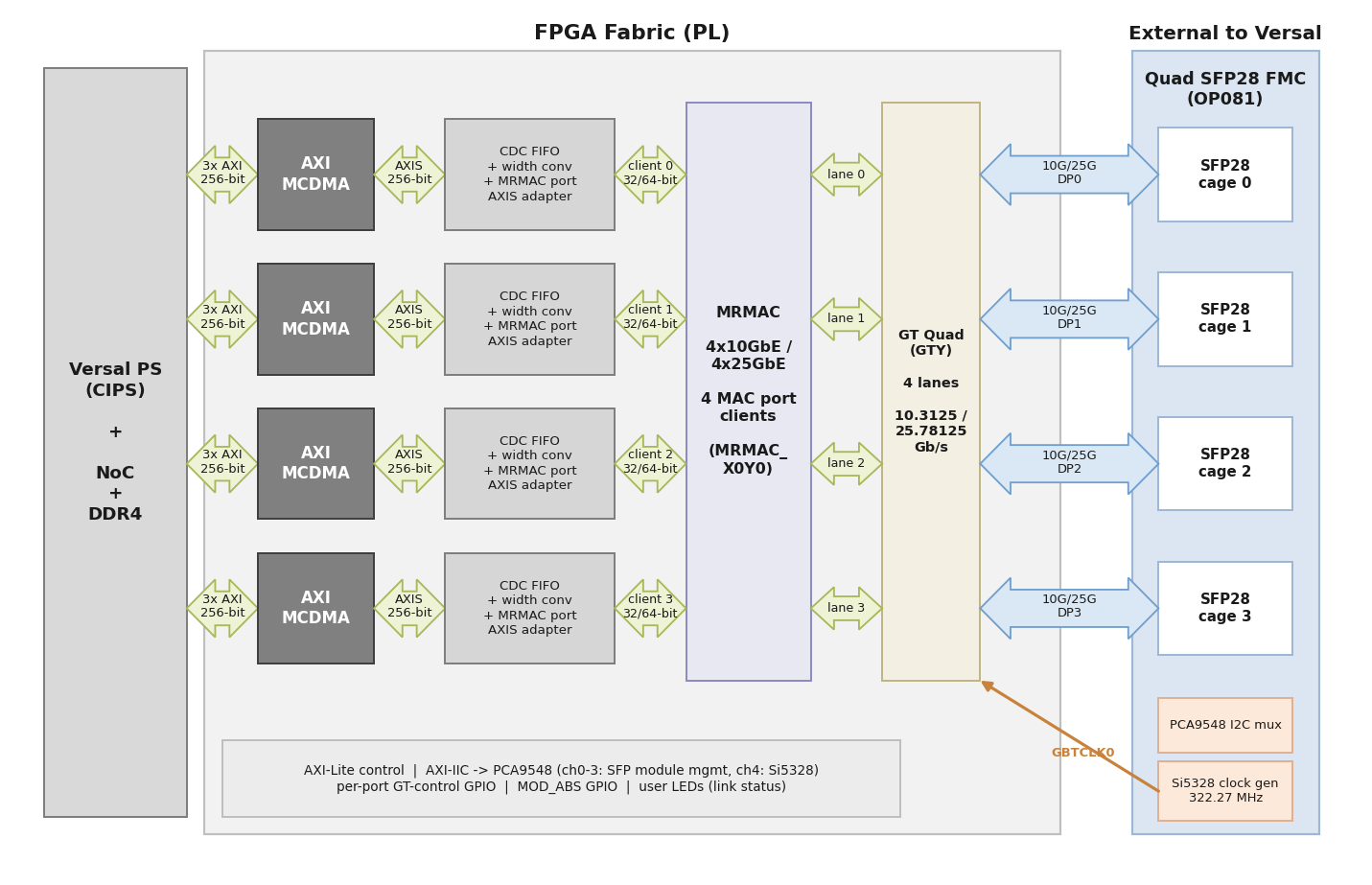
MRMAC (4x10GE or 4x25GE). The single MRMAC hard block (site
MRMAC_X0Y0) is configured with the4x10GE Wideor4x25GE Widepreset: four independent MAC ports, each with its own 64-bit non-segmented client interface (a 10GE port actively drives 32 bits of it, a 25GE port the full 64 bits), all running at the 390.625 MHz AXIS client clock.GT Quad (GTY). All four lanes of one
gt_quad_base(FMC DP0–3 = SFP28 slots 0–3) serve one port each. The complete GT configuration is derived automatically from the connected MRMAC serdes interfaces by IP integrator parameter propagation: RAW encoding, LCPLL, 322.265625 MHz reference clock, TX/RXPROGDIV output clocks at 644.531 MHz. Each lane’s TX and RX output clocks are buffered by a pair of free-running BUFG_GTs into full-rate and half-rate user clocks for that port.MRMAC client AXIS adapters. The MRMAC per-port client is not a standard AXI4-Stream bus — the data rides on loose 64-bit lane pins plus an 11-bit
tkeep_usercontrol word. Small custom RTL adapters (mrmac_port_tx_axis_adapter/mrmac_port_rx_axis_adapter) present each port’s client as a standard AXI4-Stream at the port’s active width.Datapath to DDR. Per port, a width converter (to 256 bits) and an asynchronous CDC FIFO bridge the 390.625 MHz MRMAC client clock domain to the 100 MHz system clock domain, where an AXI MCDMA moves packet data to and from DDR over three NoC AXI ports (scatter-gather, MM2S, S2MM).
Clocking. The Si5328 jitter-attenuating clock generator on the FMC sources the GT reference clock (GBTCLK0) at 322.265625 MHz. It is programmed over I2C through the card’s PCA9548 mux (channel 4; channels 0–3 are the SFP module management buses).
Control and sideband. Per port, an AXI-Lite control path reaches the MCDMA and a GT-control AXI GPIO (which lets software reset that port’s GT lane and read reset-done). Shared peripherals: the MRMAC AXI-Lite interface, one AXI IIC to the PCA9548 mux, a 4-bit MOD_ABS input GPIO (SFP module presence) and an APB3 bridge to the GT quad. The SFP
TX_DISABLElines are tied low (transmitter enabled from configuration), theRS0/RS1rate-select lines are tied low on the 10G targets and high on the 25G targets, and each slot’s user LEDs show link status (green = module present and link up, red = module present and link down).
Supported Hardware Platforms
The hardware design provided in this reference is based on Vivado and supports the AMD Versal evaluation board(s) listed below. The repository contains all necessary scripts and code to build the design for the supported platform(s):
Versal boards
Carrier board |
Supported FMC connector(s) |
10G support |
25G support |
|---|---|---|---|
FMCP1 |
✅ |
✅ |
The Quad SFP28 FMC requires a carrier board whose FMC connector routes four gigabit transceivers (one per SFP28 port) capable of the line rate, and an AMD device that contains the integrated MRMAC. The VCK190 satisfies both via its FMCP1 connector.
Supported Software
This reference design can be driven within a PetaLinux environment, or by the included bare-metal echo-server test application. The repository includes all necessary scripts and code to build both. The table below outlines the corresponding applications available:
Environment |
Available Applications |
|---|---|
Standalone |
Raw-Ethernet echo server (ARP, ICMP ping, UDP echo on all 4 ports) |
PetaLinux |
Built-in Linux commands |